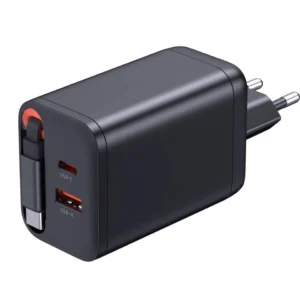
From consumer electronics to light electric vehicles and portable power stations, lithium batteries have become the core power source for modern hardware. However, their high energy density brings strict safety requirements. The longevity and safety of a battery pack rely heavily on the quality and algorithmic precision of a high-quality Lithium Battery Charger. For global OEMs, finding a professional Lithium Battery Charger partner and a trusted OEM power supply supplier is a critical step for successful project deployment.
The Critical Difference: A Dedicated Lithium Battery Charger vs. Standard Power Adapters
Many procurement managers initially confuse standard power adapters with a dedicated Lithium Battery Charger. While their external housings may look identical, their internal engineering serves completely different purposes:
-
Standard Power Adapters: These output a continuous, fixed voltage. Their sole job is to deliver steady power to a device that already contains internal power management circuitry. They do not monitor battery health or charge status.
-
Dedicated Smart Battery Charger: A true Lithium Battery Charger acts as an intelligent power manager tailored to specific battery chemistries. It executes a strict multi-stage charging profile. For lithium batteries, it initiates a Constant Current (CC) phase to rapidly replenish capacity, seamlessly transitioning to a Constant Voltage (CV) phase, and automatically cuts off the current once fully charged.
Using a standard power adapter instead of a specialized Lithium Battery Charger can lead to severe overcharging or shortened cycle life.
1. Chemistry-Specific R&D and Power Series Customization
Different chemical compositions require fundamentally different parameters from your Lithium Battery Charger:
-
Lithium-ion (Li-ion): These require a precise CC-CV charging curve from the Lithium Battery Charger to prevent overcharging. For example, if you need a custom 33.6V Li-ion charger, an industrial system might require a regulated 33.6V 3.5A output alongside a 100–240 VAC input for global use.
-
Lithium Iron Phosphate (LiFePO4): These operate on a different voltage platform. If you are looking for a reliable 14.6V LiFePO4 battery charger supplier, a custom pack may require a specialized DC 14.6V, 3A charge output from the Lithium Battery Charger to function safely.
Power Series Flexibility: Experienced manufacturers design a Lithium Battery Charger based on a specific power series. Within a fixed wattage range, voltage and current can be flexibly configured. For instance, within a 90W series, a Lithium Battery Charger can be customized to output either 24V 3.75A or 36V 2.5A. Furthermore, custom voltage ceilings can be adapted: a standard industrial battery charger system can be customized up to 48V, while special equipment from a POE power supply manufacturer can reach 56V or higher.
2. Hardware and Connector Customization for Your Lithium Battery Charger
Many industrial devices cannot use standard 5.5×2.1mm DC barrel jacks. To ensure secure connections, a customized Lithium Battery Charger requires specialized interfaces:
-
Multi-Pin Connectors: Your project may demand complex interfaces. Sourcing a battery charger with Sub-D connector capabilities ensures you can integrate specialized ports, like a 26-pin Sub-D male connector.
-
OEM Branding: A premium supplier should offer physical customization, ensuring the custom connector and the Lithium Battery Charger housing are accurately labeled with your corporate LOGO.
3. Global Safety Certifications for a Lithium Battery Charger
A Lithium Battery Charger is a high-voltage input device subject to strict market entry regulations. Lacking proper certifications can result in seized shipments:
-
North America: UL / cUL, FCC, DOE energy efficiency.
-
Europe: CE, RoHS, REACH, ERP.
-
Asia & Global: KC (Korea), PSE (Japan), RCM (Australia), and global CB reports.
4. Stringent QC and Testing for Every Lithium Battery Charger
The true baseline of a custom battery charger manufacturer lies in quality control. Every Lithium Battery Charger should pass a 100% full-load burn-in test. The internal circuit of the Lithium Battery Charger must include Over-Voltage Protection (OVP), Over-Current Protection (OCP), Short-Circuit Protection (SCP), Over-Temperature Protection (OTP), and Reverse Polarity Protection.
5. Supply Chain Agility and Engineering Support
For B2B buyers, sourcing a Lithium Battery Charger means securing long-term collaboration. Can the team evaluate complex mechanical drawings rapidly? Do they support small-batch trial runs for your custom LiFePO4 charger to transition smoothly to mass production?
In today’s hardware market, a high-quality Lithium Battery Charger is the first line of defense for device safety. If you are developing a project that requires tailored voltage outputs—whether a flexible 90W series configuration, wholesale lithium battery chargers for a 48V system, or a specialized 26-pin interface—our engineering team at Dongguan Imia Electronics Co., Ltd. is ready to review your specifications and deliver a bespoke Lithium Battery Charger solution.