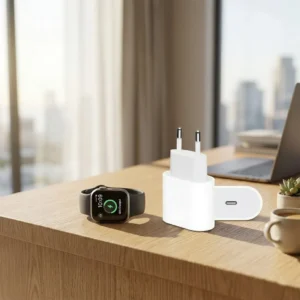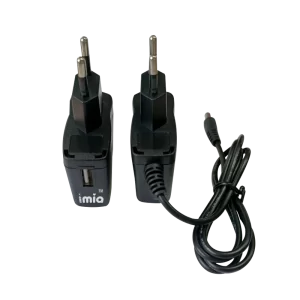
We’re surrounded by “little black bricks”—phone chargers, laptop power supplies, and LED drivers. We often use the terms “power supply” and “charger” interchangeably, but technically, they are worlds apart.
Using the wrong one won’t just result in a device that doesn’t work. It can lead to overheating, fire, or the permanent destruction of your electronics.
This article will dive deep into the core differences between these devices, from the fundamental “Difference between a power supply and a charger” to the core technologies that power them: Constant Voltage (CV) and Constant Current (CC).
1. The Core Difference: Power Supply vs. Charger
First, we must clear up the most common misconception.
-
Power Supply: Its job is to provide the energy a device needs to operate. It’s like a water pump providing steady “pressure” (voltage), allowing the device (like a laptop or LED) to “drink” (current) and work right now.
-
Charger: Its job is to replenish energy in a battery. It’s more like an intelligent bottling machine. It must manage the “flow” (current) to ensure the “bottle” (battery) is filled quickly but not so forcefully that it bursts.
The Power Supply provides immediate power for operation; the Charger manages energy storage.
2. The Two Core Modes: Constant Voltage (CV) vs. Constant Current (CC)
Whether it’s a power supply or a charger, its operation is defined by two basic modes.
⚡ Constant Voltage (CV)
-
Definition: Maintains a fixed, steady output voltage (e.g., 5V, 12V, 24V).
-
How it works: The voltage is locked, and the current it delivers varies based on the load (what’s connected to it).
-
Applications:
-
Most Electronics: Your laptop, router, and monitor all require a stable voltage to function.
-
“Constant voltage power supply for LED applications”: This is ideal for LED strips. Why? Because LED strips are designed with on-board current-limiting resistors. They just need a stable 12V or 24V source to work correctly.
-
⚡ Constant Current (CC)
-
Definition: Maintains a fixed, steady output current (e.g., 350mA, 700mA).
-
How it works: The current is locked, and the voltage automatically adjusts to match the load.
-
Applications:
-
High-Power LEDs: This is the primary use for CC. A single LED (like in a spotlight) is extremely sensitive to current.
-
“Constant current LED driver prevents thermal runaway”: This is a critical concept. As an LED heats up, its internal resistance drops. If you use a CV (Constant Voltage) supply, the stable voltage combined with lower resistance (Ohm’s Law: $I = V/R$) would cause the current ($I$) to skyrocket. This makes the LED even hotter, lowering its resistance further… a vicious cycle called “Thermal Runaway” that ends in a burnt-out LED. A Constant Current driver stops this by forcing the current to stay the same, regardless of temperature changes.
-
3. Application Case 1: Selecting LED Lighting Solutions
When “Selecting LED lighting solutions with proper power supplies,” you have to make a choice.
“How to choose between constant current and constant voltage LED drivers for LEDs”:
-
Choose a Constant Voltage (CV) driver if:
-
You are using LED strips.
-
You are using LED modules that already have drivers or resistors built-in.
-
You need to wire many LED units in parallel and want them all to receive the same voltage.
-
-
Choose a Constant Current (CC) driver if:
-
You are using high-power LEDs, either individually or wired in series (e.g., COB spotlights, streetlights).
-
Your LED device is explicitly rated for a “XXX mA” constant current input.
-
You are seeking maximum efficiency, brightness control, and the longest possible LED lifespan.
-
4. Application Case 2: The Modern Battery Charger
This is perhaps the most elegant application of both modes working together. A modern Battery Charger, especially a “CC-CV battery charger design for lithium battery safety,” perfectly demonstrates this partnership.
“Charger uses constant voltage mode and constant current mode explained”:
A lithium-ion battery’s charging process typically has three stages:
-
Pre-Charge (if needed): If the battery is deeply discharged, the charger uses a tiny, gentle current to safely wake it up.
-
Constant Current (CC) Stage: This is the main charging phase. The battery is at a low voltage, so the charger feeds it the fastest, safest, constant current (e.g., 2A). During this time, the battery’s voltage steadily rises.
-
Constant Voltage (CV) Stage: Once the battery’s voltage hits its peak (e.g., 4.2V), the charger instantly switches modes. It locks the voltage at 4.2V and holds it there. As the battery becomes full, its internal resistance rises, and the charging current naturally drops.
-
Termination: When the current drops to a very low level (e.g., 0.1A), the charger, which might be a Smart Charger, knows the battery is full and stops the process completely.
This CC-CV mechanism is the key to charging batteries both quickly and safely, preventing dangerous overcharging.
5. Advanced Topics: Power Conversion and Circuit Design
How is this complex logic achieved?
-
DC-DC Converters:
-
“Step-down DC-DC converter for powering LED strips and low voltage devices”: This is used to take a higher voltage (e.g., a 24V power adapter) and efficiently “step it down” to 12V for an LED strip or 5V for a USB device.
-
-
“Step-up DC-DC converter for boosting battery charging voltage”: This can take a 5V USB input and “boost” it to the 12.6V needed to charge a 3-cell (11.1V) lithium battery pack.
-
Converting a Power Supply into a Charger:
-
Can you go about “Using diodes and feedback circuits to convert a power supply into a charger”?
-
Technically, yes, but it is extremely ill-advised for modern batteries.
-
A simple diode only prevents reverse current; it cannot perform the CC-CV logic.
-
A proper conversion requires a complex “Feedback circuit design in charger conversion and regulation”. This feedback circuit must actively monitor both the output voltage and current, and then dynamically control the DC-DC converter to follow the precise CC-CV charging curve.
-
6. Conclusion: How to Make the Right Choice
Finally, let’s return to that all-encompassing term: the Power Adapter.
When “Choosing the right power adapter for LED drivers and battery chargers,” you must remember:
-
Read the Label!
-
Output: 12V ⎓ 2A(fixed V) = Constant Voltage (CV) Power Supply. -
Output: 700mA, 20-40VDC(fixed A) = Constant Current (CC) LED Driver. -
Output: 4.2V / 1A(often with “Charger” or a battery icon) = Battery Charger.
-
-
Use the Right Tool for the Job!
-
NEVER use a CV Power Supply to directly power a high-power LED (it will burn out).
-
NEVER use a CC LED Driver to power your laptop (it will be damaged).
-
NEVER use a standard CV Power Supply to charge a lithium-ion battery (this is extremely dangerous and a major fire hazard).
-
Understanding the difference between CV and CC isn’t just technical trivia—it’s a critical step in keeping your devices, and yourself, safe.